
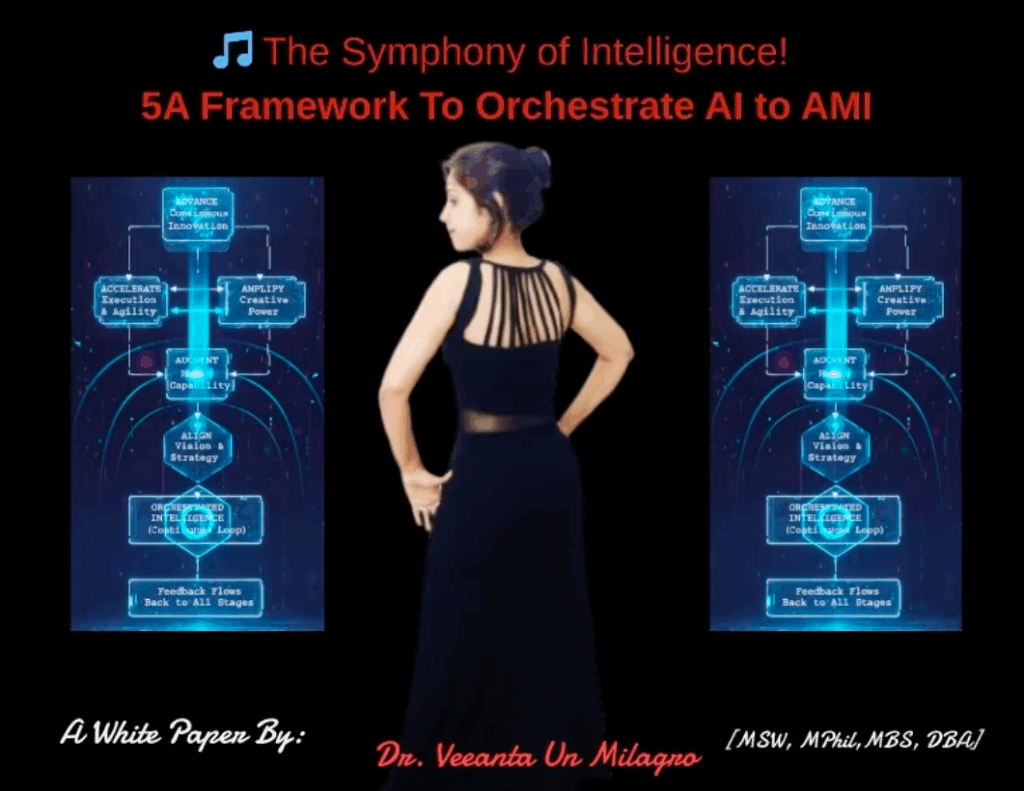
Align. Augment. Amplify. Accelerate. Advance
– White Paper By: Dr. Veeanta Un Milagro [MSW, MPhil, MBS, DBA]
Executive Summary
In an era where Advancing Machine Intelligence (AMI) permeates every facet of business and society, organizations face a critical challenge: how to harness AMI’s transformative power while maintaining strategic coherence, ethical integrity, and human-centric values. The answer lies not in viewing AMI as a standalone technology, but as an orchestrated symphony where multiple elements harmonize to create extraordinary outcomes.
This white paper introduces the 5A Framework, a comprehensive methodology for orchestrating AMI implementation across five interconnected dimensions: Align, Augment, Amplify, Accelerate, and Advance. These are not sequential stages but simultaneous, continuously operating elements that form a dynamic system of organizational intelligence.
A Dynamic, Cyclic, and Simultaneous Framework. The 5A Framework is intentionally designed as a dynamic spiral rather than a linear sequence. Organizations do not complete one stage before beginning another; instead, all five dimensions operate simultaneously and continuously, each informing and reinforcing the others in a perpetual cycle of evolution. Like a symphony where multiple instruments play concurrently to create harmonic resonance, Alignment continues even as you Accelerate, while Advancement insights loop back to refine Augmentation strategies. This cyclic, rotating nature ensures that orchestration remains adaptive, responsive, and progressively sophisticated, spiraling upward with each iteration toward higher levels of intelligence maturity.
Beyond Artificial Intelligence: Building Foundations for the Future. While organizations today are implementing and orchestrating traditional AI systems, the critical imperative is to establish the foundational architecture, governance structures, and human-centric practices that will enable the transition to true AMI. This framework recognizes that we are at an inflection point, moving from rule-based automation and pattern recognition toward adaptive, reasoning, and collaborative machine intelligence. As we orchestrate current AI capabilities and deploy agentic workforce solutions, autonomous agents that can perceive, decide, and act with minimal human intervention, we must simultaneously lay the groundwork for AMI systems that will exhibit causal reasoning, creative synthesis, and ethical judgment. The 5A Framework serves this dual purpose: optimizing today’s AI implementations while building the organizational DNA required for tomorrow’s Advancing Machine Intelligence ecosystem, where human ingenuity and machine capability converge in unprecedented ways.
Introduction: The Need for Orchestration
The proliferation of AMI technologies has created a paradox: while tools become more powerful, organizational outcomes remain inconsistent. Companies invest heavily in AMI solutions yet struggle to realize proportional returns. The root cause is fragmentation, AMI initiatives deployed in silos, disconnected from strategic vision, and implemented without cohesive orchestration.
Orchestration is the deliberate coordination of AMI capabilities across people, processes, and platforms to achieve unified outcomes. Like a symphony conductor who transforms individual instruments into harmonious music, organizations must coordinate AMI elements to create strategic value greater than the sum of individual parts.
The stakes are substantial. According to industry research, organizations with orchestrated AMI strategies report 3.5x higher productivity gains and 2.8x faster innovation cycles compared to those with fragmented approaches. Yet only 23% of organizations have achieved true AMI orchestration.
Let’s see why the traditional approach of implementing AMI in sequential phases, first strategy, then pilots, then scaling is fundamentally flawed. True orchestration requires all elements to operate concurrently, creating feedback loops and synergies that compound over time. Organizations must think and act multidimensionally, conducting all five movements of the intelligence symphony simultaneously.
The 5A Framework: A Comprehensive Model
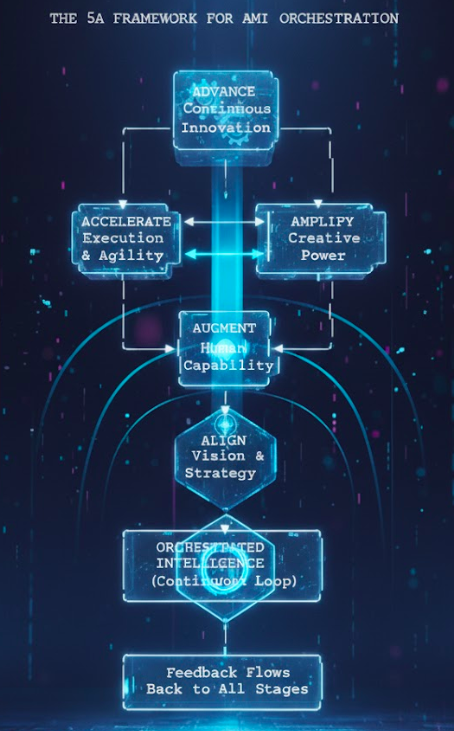
The 5A Framework operates as an interconnected system where each dimension continuously influences and is influenced by the others. There is no starting point or ending point, only continuous cycles of refinement and evolution. Organizations enter the framework wherever they are and begin orchestrating all five dimensions simultaneously, with each rotation through the cycle deepening capability and impact.
The Five Dimensions of AMI Orchestration
ALIGN: Foundation of Purpose
Definition: Alignment ensures AMI initiatives synchronize with organizational vision, mission, strategic objectives, ethical principles, and long-term goals, continuously and dynamically.
Dynamic Nature: Alignment is not a one-time activity but an ongoing process. As organizational strategy evolves, as new ethical considerations emerge, and as AMI capabilities advance, alignment must continuously recalibrate. Insights from Acceleration reveal new strategic opportunities; Amplification uncovers cultural dynamics requiring attention; Advancement pushes the boundaries of what’s ethically possible, all feeding back into refined alignment.
Implementation Dimensions:
Strategic Alignment:
- Continuously map AMI capabilities to evolving business objectives
- Identify and reassess mission-critical processes for AMI integration
- Maintain living success metrics tied to organizational KPIs
- Foster executive sponsorship that adapts with organizational change
Ethical Alignment:
- Define and evolve AMI ethics principles (transparency, fairness, accountability, privacy)
- Establish continuous bias detection and mitigation protocols
- Implement adaptive human oversight mechanisms
- Build stakeholder trust through demonstrated responsible AMI practices
Cultural Alignment:
- Continuously assess organizational readiness and adapt change strategies
- Address emerging workforce concerns proactively
- Build and deepen AMI literacy across all organizational levels
- Foster a culture of continuous learning and experimentation
Cross-Dimensional Connections:
- Alignment informs Augmentation by defining which human capabilities to enhance
- Alignment sets guardrails for Acceleration, ensuring speed doesn’t compromise values
- Alignment provides direction for Advancement research priorities
- Feedback from Amplification reveals cultural barriers requiring alignment attention
Real-World Dynamic: A global financial services firm maintains quarterly alignment reviews where insights from their AMI implementations (Augment, Amplify, Accelerate) inform strategic pivots. When their Amplification initiatives revealed unexpected collaboration patterns, they realigned their AMI roadmap, resulting in 340% ROI within 18 months.
AUGMENT: Enhancing Human Capability
Definition: Augmentation leverages AMI to enhance human intelligence, decision-making, and productivity without replacing human judgment, continuously adapting to user needs and organizational context.
Dynamic Nature: Augmentation evolves as both AMI capabilities and human needs develop. The systems learn from usage patterns (Advance), organizational knowledge expands (Amplify), processes become more sophisticated (Accelerate), and strategic priorities shift (Align). Human-AMI partnerships mature over time, becoming more nuanced and effective with each cycle.
Implementation Dimensions:
Cognitive Augmentation:
- Deploy adaptive AMI-powered decision support systems that learn from user feedback
- Implement intelligent assistants that evolve with knowledge workers’ needs
- Use predictive analytics that continuously refine forecasting models
- Provide contextual real-time insights that improve with each decision cycle
Operational Augmentation:
- Automate routine tasks while continuously identifying new automation opportunities
- Implement intelligent document processing that learns organizational patterns
- Deploy conversational AMI that improves through every interaction
- Use computer vision systems that enhance accuracy through continuous learning
Skills Augmentation:
- Create AMI-powered learning platforms that personalize to individual growth trajectories
- Provide adaptive skill development paths that respond to organizational needs
- Use AMI coaches that refine performance feedback based on outcomes
- Implement simulation environments that evolve in complexity as skills develop
Cross-Dimensional Connections:
- Augmentation creates data that feeds Amplification’s knowledge synthesis
- Augmentation efficiencies enable resources for Advancement research
- Insights from user interactions inform Alignment of strategic priorities
- Augmentation automation accelerates processes in the Accelerate dimension
Measurement Evolution: Track augmentation effectiveness not just through static productivity metrics but through dynamic indicators: decision quality improvement trajectories, time savings acceleration rates, employee satisfaction trends, and human-AMI collaboration maturity scores that capture the evolving partnership quality.
AMPLIFY: Multiplying Collective Intelligence
Definition: Amplification harnesses AMI to multiply creativity, insights, and organizational intelligence through data-driven collaboration and knowledge synthesis, continuously expanding the network effects of collective intelligence.
Dynamic Nature: As more individuals are Augmented, the Amplification potential grows exponentially. Each new insight feeds the knowledge base, each collaboration strengthens the network, and each creative output becomes a building block for future innovation. Amplification creates virtuous cycles where organizational intelligence compounds over time.
Implementation Dimensions:
Knowledge Amplification:
- Implement dynamic organizational knowledge graphs that grow and evolve
- Deploy AMI-powered research tools that continuously surface relevant connections
- Create intelligent knowledge management systems that learn organizational semantics
- Enable cross-functional insight sharing that strengthens with each contribution
Creative Amplification:
- Use generative AMI that learns organizational creative patterns and preferences
- Implement design assistance tools that evolve with usage
- Deploy scenario modeling that incorporates learnings from previous simulations
- Create innovation labs where AMI capabilities expand through experimentation
Collaborative Amplification:
- Implement AMI-enhanced collaboration platforms that optimize team dynamics
- Use intelligent meeting assistants that learn from successful collaboration patterns
- Deploy sentiment analysis that tracks team health trends over time
- Create recommendation engines that improve expertise matching with each connection
Data Amplification:
- Establish unified data platforms that continuously integrate new sources
- Implement analytics that reveal increasingly sophisticated patterns
- Deploy real-time business intelligence that adapts to information needs
- Create predictive models that refine with each forecast cycle
Cross-Dimensional Connections:
- Amplification reveals strategic opportunities that inform Alignment
- Collective insights accelerate innovation in the Advance dimension
- Knowledge synthesis enables faster Acceleration of processes
- Collaboration patterns inform how to better Augment teams
Compound Effects: A pharmaceutical research organization’s AMI-powered knowledge synthesis platform demonstrates the compounding nature of Amplification. Initial implementations reduced drug discovery cycle time by 40%, but as the system learned from more research cycles and more scientists contributed insights, the acceleration increased to 62% successful compound identification, with performance continuing to improve each quarter.
ACCELERATE: Speed and Agility
Definition: Acceleration leverages AMI to compress timelines, automate workflows, and enable agile delivery across the organization, continuously optimizing for speed without sacrificing quality or alignment.
Dynamic Nature: Acceleration is not about running faster in the same direction; it’s about continuously finding smarter, faster paths. As processes are automated (Accelerate), human capacity is freed for higher-value work (Augment). As workflows accelerate, new bottlenecks emerge, triggering new automation cycles. Speed creates data that informs Advancement, which creates new capabilities that enable further acceleration, a perpetual spiral upward.
Implementation Dimensions:
Process Acceleration:
- Continuously map and optimize end-to-end workflows
- Implement intelligent process automation that self-improves
- Deploy robotic process automation that learns from exceptions
- Use AMI for dynamic resource allocation that adapts in real-time
Development Acceleration:
- Implement AMI-assisted software development that evolves with codebases
- Use automated testing that expands coverage with each release
- Deploy CI/CD pipelines with AMI optimization that learns from deployments
- Create low-code/no-code platforms that become more powerful through use
Decision Acceleration:
- Implement real-time data pipelines that optimize for latency reduction
- Deploy automated decision engines that refine rules based on outcomes
- Use AMI for risk assessment that incorporates latest market intelligence
- Create executive dashboards that adapt visualizations to decision patterns
Market Acceleration:
- Deploy AMI-powered market intelligence that tracks emerging trends
- Implement dynamic pricing that learns optimal strategies
- Use predictive demand forecasting that improves with each cycle
- Create personalized customer experiences that refine through interactions
Cross-Dimensional Connections:
- Acceleration frees human capacity for deeper Augmentation
- Speed creates more data points for Amplification insights
- Rapid cycles enable faster Advancement experimentation
- Process efficiency supports resource allocation for strategic Alignment
Velocity Metrics: Track not just static speed metrics but acceleration rates: cycle time reduction trajectories, throughput improvement curves, time-to-market compression trends, and efficiency gain acceleration, all indicating the compounding benefits of continuous optimization.
ADVANCE: Beyond Artificial Intelligence
Definition: Advancement represents the commitment to continuous innovation, pushing beyond current limitations toward next-generation Advancing Machine Intelligence, constantly exploring the frontiers of what’s possible.
Dynamic Nature: Advancement is the engine of evolution. Research insights from Advance create new capabilities for Augment. Experimental innovations from Advance enable breakthrough Amplification. Advancement discoveries accelerate the Accelerate dimension. And cutting-edge explorations challenge and refine Alignment. This dimension ensures the framework never stagnates but continuously spirals upward toward more sophisticated intelligence.
From AI to AMI: The Continuous Journey
Traditional Artificial Intelligence represents pattern recognition, prediction, and automation based on historical data. Advancing Machine Intelligence transcends these boundaries through continuous evolution, characterized by:
- Adaptive Learning: Systems that continuously evolve based on context, experience, and environmental changes
- Causal Reasoning: Progressive development from correlation to causation understanding
- Creative Problem-Solving: Expanding capacity to generate novel solutions to unprecedented challenges
- Ethical Reasoning: Evolving capability to navigate increasingly complex moral landscapes
- Collaborative Intelligence: Deepening integration with human cognition over time
Implementation Dimensions:
Innovation Culture:
- Establish dedicated AMI research functions with continuous exploration mandates
- Create innovation sandboxes that evolve experimental boundaries
- Foster partnerships with academic institutions that advance state-of-the-art
- Allocate resources for exploratory initiatives with learning-focused metrics
Continuous Learning Systems:
- Implement perpetual feedback loops for all AMI systems
- Deploy adaptive testing frameworks that evolve with capabilities
- Create mechanisms for capturing and learning from edge cases
- Establish model governance that enables continuous improvement
Future-Readiness:
- Continuously monitor and evaluate emerging AMI technologies
- Conduct regular AMI maturity assessments that measure evolution rate
- Invest in next-generation infrastructure with adaptation capacity
- Develop talent pipelines that emphasize continuous learning
Ethical Evolution:
- Advance responsible AMI frameworks as capabilities expand
- Participate in industry standards development with forward-looking perspective
- Proactively address emerging societal implications
- Build trust through demonstrated commitment to evolving responsibility
Cross-Dimensional Connections:
- Advancement breakthroughs enable new forms of Augmentation
- Research insights reveal new Amplification possibilities
- Experimental capabilities enable unprecedented Acceleration
- Frontier exploration informs strategic Alignment evolution
- Every cycle through the framework generates insights that fuel Advancement
Philosophical Shift: The Advance dimension embodies the framework’s cyclic nature. It’s not a final destination but a continuous commitment to evolution. Each rotation through the 5A framework generates learnings that fuel the next cycle of innovation, creating an upward spiral of capability development.
The Orchestration Mindset: Operating Principles
Successful AMI orchestration requires embracing a fundamentally different operational mindset:
1. Simultaneity Over Sequence All five dimensions operate concurrently from day one. While initial emphasis might vary, organizations must activate all dimensions simultaneously rather than waiting to complete one before starting another. A pilot project should incorporate Alignment principles, Augment specific capabilities, contribute to Amplification, Accelerate a process, and generate learnings for Advancement—all at once.
2. Cyclical Progression Over Linear Completion There is no “finished” state. Each cycle through the framework deepens capability. The first cycle might achieve 20% of potential; the fifth cycle might reach 80%; the twentieth cycle continues discovering new possibilities. Organizations measure progress not by completion but by evolution velocity—how quickly they’re spiraling upward.
3. Systemic Thinking Over Siloed Implementation Every AMI initiative touches all five dimensions. A decision support system (Augment) must align with strategy (Align), contribute insights to collective intelligence (Amplify), accelerate decision cycles (Accelerate), and generate learnings for future capabilities (Advance). Orchestration means seeing and activating these connections.
4. Feedback Sensitivity Over Plan Rigidity The framework thrives on feedback. Insights from one dimension continuously inform others. Organizations must build sensors throughout their AMI ecosystem to detect signals, interpret patterns, and adapt rapidly. Strategic plans remain directional but flexible, evolving with each cycle’s learnings.
5. Human-Centricity as Constant While technology evolves through all dimensions, human wellbeing, judgment, and creativity remain central. Every cycle must enhance human capability, not diminish it. AMI serves human purposes; humans don’t serve AMI requirements.
6. Compounding Effects Through Persistence The framework’s power comes from sustained commitment. Early cycles yield linear improvements; later cycles create exponential gains through network effects, knowledge accumulation, and capability compounding. Organizations must persist through initial cycles to reach the acceleration point where benefits multiply.
Dynamic Implementation: The Spiral Approach
Rather than traditional phased implementations, the 5A Framework uses a spiral approach where all dimensions operate simultaneously but with evolving emphasis and sophistication.
Cycle 1: Foundation Spiral (Months 1-6) All dimensions activate; emphasis on establishing foundations
Align:
- Conduct comprehensive AMI readiness assessment
- Establish governance frameworks and ethical principles
- Define strategic alignment criteria and success metrics
- Build cross-functional orchestration team
Augment:
- Identify and launch 2-3 quick-win augmentation pilots
- Deploy initial decision support tools for key roles
- Implement basic intelligent assistants
Amplify:
- Establish foundational data infrastructure
- Launch initial knowledge sharing platforms
- Create collaboration mechanisms for pilot teams
Accelerate:
- Identify and map critical workflow bottlenecks
- Implement first automation initiatives
- Establish baseline performance metrics
Advance:
- Define innovation pipeline and research priorities
- Establish experimentation framework
- Begin monitoring emerging AMI technologies
Cycle 1 Outcome: Organizations have active initiatives in all five dimensions, generating early wins while building infrastructure for deeper orchestration.
Cycle 2: Deepening Spiral (Months 7-18) All dimensions intensify; emphasis on connections and feedback loops
Align:
- Refine strategic alignment based on Cycle 1 learnings
- Deepen cultural change initiatives informed by adoption patterns
- Adjust governance based on emerging needs
Augment:
- Scale successful pilots based on user feedback
- Introduce more sophisticated augmentation capabilities
- Personalize AMI tools to individual and team needs
Amplify:
- Connect individual augmentation data into collective insights
- Launch cross-functional knowledge synthesis initiatives
- Deploy advanced collaboration and creative tools
Accelerate:
- Automate additional workflows informed by bottleneck analysis
- Optimize initial automations based on performance data
- Begin end-to-end process transformation
Advance:
- Launch exploratory projects in next-generation capabilities
- Pilot experimental AMI technologies
- Begin transition planning from AI to AMI
Cycle 2 Outcome: Dimensions begin showing clear interdependencies. Augmentation data feeds Amplification; Acceleration creates capacity for Advancement; strategic Alignment evolves with demonstrated capabilities.
Cycle 3: Scaling Spiral (Months 19-36) All dimensions mature; emphasis on scaling and optimization
Align:
- AMI strategy becomes embedded in overall business strategy
- Ethical frameworks adapt to expanding capabilities
- Cultural transformation reaches maturity with AMI as “how we work”
Augment:
- Augmentation reaches enterprise scale across functions
- Human-AMI partnerships show sophisticated collaboration patterns
- Personalization enables individual productivity breakthroughs
Amplify:
- Collective intelligence becomes organizational superpower
- Knowledge synthesis drives strategic innovation
- Collaboration platforms enable seamless cross-boundary work
Accelerate:
- Core processes show dramatic cycle time reductions
- Automation cascades create compounding efficiency gains
- Agility becomes organizational characteristic
Advance:
- AMI capabilities begin showing causal reasoning
- Creative problem-solving emerges in experimental systems
- Organization recognized as AMI innovation leader
Cycle 3 Outcome: The five dimensions operate as integrated system. Benefits multiply through network effects. Organization achieves competitive differentiation through orchestrated intelligence.
Cycle 4+: Continuous Evolution (Ongoing) All dimensions in mature operation; emphasis on frontier exploration
Each subsequent cycle:
- Deepens capability in all dimensions simultaneously
- Discovers new interdependencies and synergies
- Pushes boundaries of what’s possible with AMI
- Maintains alignment as organizational context evolves
- Generates insights that fuel the next cycle
The spiral continues indefinitely, with each rotation building on previous cycles’ foundations while exploring new frontiers. There is no final state—only continuous evolution toward higher orders of orchestrated intelligence.
Measuring Dynamic Orchestration Success
Measurement in a dynamic framework differs from traditional project metrics. Organizations track:
Evolutionary Metrics (Measuring Cycle-to-Cycle Progress):
- Capability maturity scores across all five dimensions
- Interdimensional connection strength (how well dimensions inform each other)
- Cycle velocity (time to complete learning cycles)
- Compounding benefit rates (acceleration of value creation)
Dimensional Health Metrics:
Align:
- Strategic coherence scores (alignment between AMI and business initiatives)
- Ethical compliance rates
- Cultural readiness indices
- Stakeholder trust measures
Augment:
- Human productivity enhancement trajectories
- Decision quality improvement rates
- Employee satisfaction with AMI tools trends
- Human-AMI collaboration maturity scores
Amplify:
- Collective intelligence growth rates
- Cross-functional collaboration frequency and quality
- Knowledge synthesis impact on innovation
- Network effects strength
Accelerate:
- Cycle time reduction trajectories across processes
- Automation coverage expansion rates
- Time-to-market compression trends
- Agility response time improvements
Advance:
- Innovation pipeline velocity
- Experimental success rates and learnings
- Next-generation capability adoption rates
- Competitive differentiation metrics
Systemic Metrics (Measuring Orchestration Quality):
- Return on AMI investment with attribution across dimensions
- Strategic goal achievement rates
- Market position evolution
- Organizational resilience and adaptability
- Innovation output quantity and quality
Leading Indicators:
- Cross-dimensional initiative percentages (how many initiatives touch multiple dimensions)
- Feedback loop cycle times (how quickly insights from one dimension inform others)
- Experimentation rates across the organization
- Strategic pivot speed based on AMI insights
Conclusion: The Future Is Orchestrated
The organizations that will thrive in the intelligence age are not those with the most AMI tools, but those that orchestrate AMI most effectively through continuous, simultaneous, and interconnected action across all five dimensions.
The Symphony of Intelligence, the 5A Framework, represents a fundamental shift from linear implementation to dynamic orchestration, from sequential phases to simultaneous dimensions, from project completion to continuous evolution.
Align, Augment, Amplify, Accelerate, and Advance are not stages to complete but dimensions to continuously activate, deepen, and integrate. They form a living system where each element strengthens the others, creating compounding benefits that spiral upward with each cycle.
The journey from Artificial Intelligence to Advancing Machine Intelligence represents humanity’s collaborative evolution with the technologies we create. But this evolution doesn’t happen through technology alone, it requires orchestrated human effort, strategic intention, ethical commitment, and persistent execution across all dimensions simultaneously.
Organizations beginning this journey should not ask “Which stage do we start with?” but rather “How do we activate all five dimensions today?” Those already implementing AMI should not ask “Have we completed alignment?” but rather “How is our latest alignment cycle informing our current augmentation, amplification, acceleration, and advancement?”
The framework’s power lies in its dynamic nature. Early cycles lay foundations. Middle cycles build capabilities. Later cycles unlock exponential benefits. But the journey never ends, there is always another cycle, another spiral upward, another frontier to explore.
The symphony awaits its conductor. But unlike traditional orchestration where the conductor stands separate from the musicians, in the Symphony of Intelligence, every member of the organization conducts, every team plays instruments, and every cycle creates new music. The question is not whether to orchestrate AMI, but how skillfully your organization will embrace the continuous, simultaneous, evolving dance of the five dimensions.
The future of intelligence is not artificial, it’s advancing, collaborative, and orchestrated. And it unfolds not in sequential steps, but in spirals of continuous evolution where vision aligns, humans augment, collective intelligence amplifies, execution accelerates, and frontiers continuously advance.
Welcome to the age of orchestrated intelligence. The spiral begins now!
Supporting Research
This framework is supported by emerging research in AMI orchestration, human-AMI collaboration, and advancing machine intelligence:
1. Secundo, G., Spilotro, C., Gast, J., & Corvello, V. (2025). “The transformative power of artificial intelligence within innovation ecosystems: a review and a conceptual framework.” Review of Managerial Science, 19(9), 2697-2728. This comprehensive review examines AMI’s transformative role within innovation ecosystems, providing a conceptual framework for understanding how AMI enables ecosystem orchestration, knowledge integration, and collaborative innovation. The research validates the systemic approach of the 5A Framework, particularly the Amplify and Advance dimensions, demonstrating how AMI transforms organizational and inter-organizational innovation capabilities through ecosystem-level orchestration.
2. Vaccaro, A.G., et al. (2024). “When combinations of humans and AI are useful: A systematic review and meta-analysis.” Nature Human Behaviour. Through systematic analysis of recent research, this paper found that on average, human-AMI systems performed better than humans alone but did not exhibit synergy compared to the best of either humans or AMI alone. This underscores the critical importance of the Augment dimension in our framework—proper orchestration determines whether human-AMI collaboration delivers value or falls short of potential.
3. Walzner, D.D. (2024). “Roles of Artificial Intelligence in Collaboration with Humans: Automation, Augmentation, and the Future of Work.” Management Science. This research provides empirical evidence for task allocation frameworks, demonstrating that allocating tasks effectively to humans and AMI can have strong benefits in terms of quality, with the framework allocating 80% of humans to the 20% most difficult tasks where human judgment excels. This directly supports the Augment and Amplify dimensions of the 5A Framework.
4. Kolbjørnsrud, V. (2024). “Designing the Intelligent Organization: Six Principles for Human-AI Collaboration.” California Management Review. Kolbjørnsrud’s framework identifies multiple configurations of organizational intelligence, including augmented intelligence when a person collaborates with intelligent technology and augmented collective intelligence when multiple people and intelligent technologies collaborate. This research validates the progression from individual augmentation to collective amplification in our framework.
5. Rigobon, R. & Loaiza, I. (2025). “The EPOCH of AI: Human-Machine Complementarities at Work.” MIT Sloan School of Management. This groundbreaking study presents evidence that there are many critical human-intensive tasks that cannot be done effectively entirely by machines, with an increase in the amount of human-intensive tasks between 2016 and 2024. The research supports the framework’s emphasis on human-centric AMI orchestration and the evolution toward Advancing Machine Intelligence that complements rather than replaces human capabilities.
These studies collectively validate the need for systematic AMI orchestration frameworks that align technology with strategy, augment human capabilities thoughtfully, amplify collective intelligence, accelerate execution, and advance toward more sophisticated machine intelligence systems.
About This Framework
The 5A Framework represents a synthesis of strategic management principles, AMI implementation best practices, and organizational change methodologies. It is designed to be industry-agnostic and scalable, applicable to enterprises, mid-market organizations, and startups alike.
For organizations beginning their orchestration journey, activate all five dimensions simultaneously, even if modestly at first. For those already implementing AMI, assess the connections between dimensions and strengthen feedback loops. For leaders in AMI adoption, focus on increasing spiral velocity and exploring frontier capabilities in the Advance dimension.
The future of intelligence is not artificial, it’s advancing, collaborative, and orchestrated through the continuous, simultaneous evolution of all five dimensions working in concert.
White Paper By: Dr. Veeanta Un Milagro [MSW, MPhil, MBS, DBA]
To Connect Write To : veeanta@cognitbotz.com